AITM keeps a fair amount of state locally so it can operate reliably and remember what it has learned about your projects. This is a plain-language map of what's stored, and why it matters to you.
What Data AITM Stores
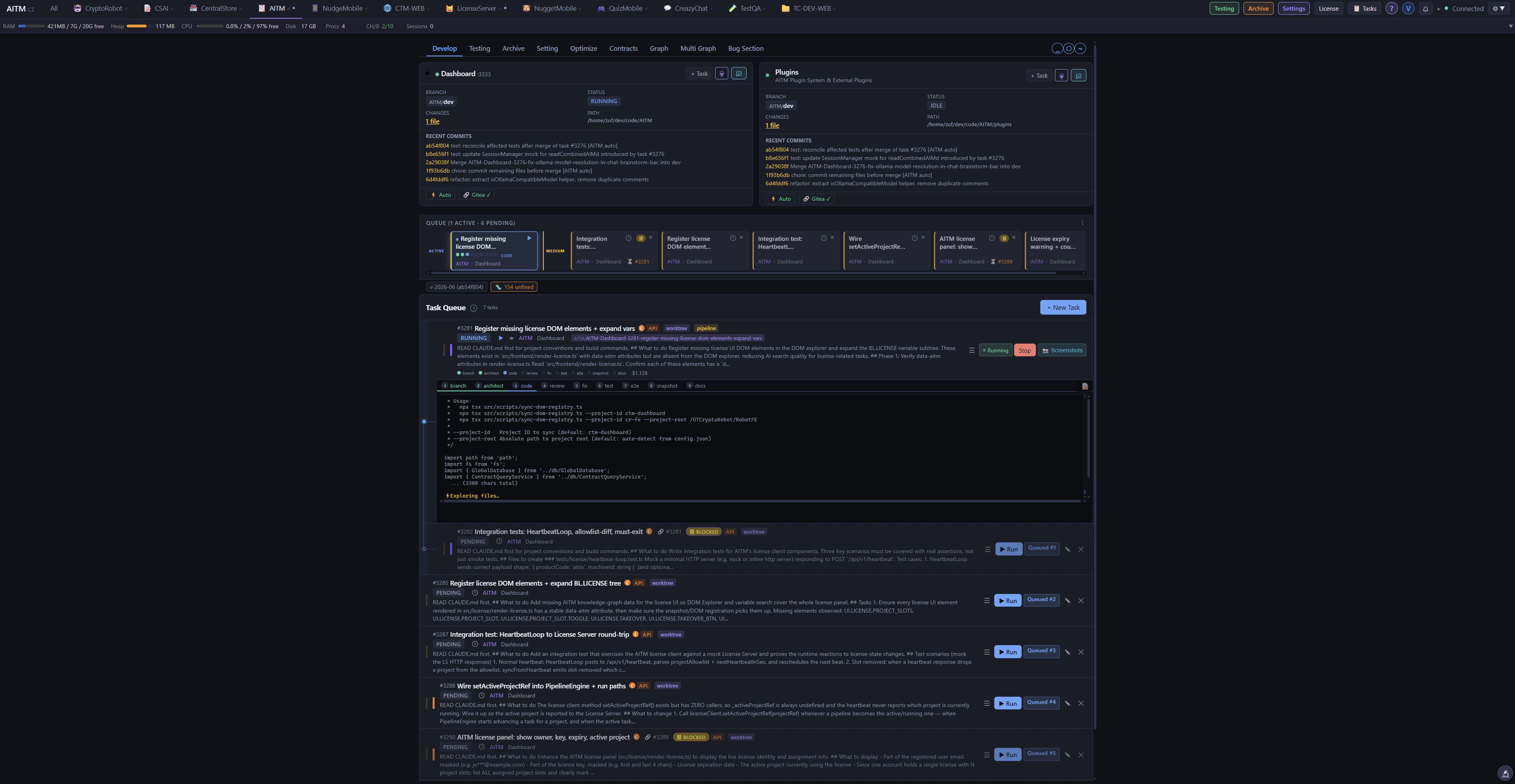
The data map
| What it is | Where it lives | Why it matters |
|---|---|---|
| Per-project database | A dedicated database file for each managed project | Holds that project's contracts and task history — kept separate per project, so one project's data never mixes with another's |
| Global database | One shared database for AITM itself | Holds application-wide settings, hints, the variable registry, and other cross-project configuration |
| Task execution logs | Per-project log folders | The detailed, line-by-line record of what happened while a task ran — useful for debugging a task that behaved unexpectedly |
| Task data folders | Per-project task folders, one subfolder per task number | Contains that task's result files, metadata, and any screenshots captured for it — this powers the Results & Archive view |
| Worktrees | Temporary Git checkouts, one per running task | The isolated working copy a task's AI agents actually edit; created when a task starts and removed automatically once it's merged — see The Pipeline |
| Knowledge graph documents | Auto-generated documentation files | Human-readable exports of the contracts and dependency knowledge described in Knowledge Sharing; regenerated automatically after every merge |
Why local, persisted state matters
None of this is incidental bookkeeping — it's the mechanism behind everything covered elsewhere in this guide:
- The per-project database is what lets contracts, task history, and precedent lookups survive between sessions and between tasks, instead of resetting every time you close the app.
- Task data folders are what make the Archive a genuinely useful audit trail rather than a list of titles — every result, screenshot, and metadata field you see there is read straight from these folders.
- Worktrees are the mechanical foundation of the isolation guarantee described in The Pipeline — because each task gets a truly separate filesystem checkout, in-progress work can never leak into your main branch by accident.
- The knowledge graph documents are what turn "the AI happened to remember something" into "the project has a durable, inspectable record of its own behavior" — see Knowledge Sharing.
How database backups are protected from unbounded growth and silent data loss
Database backups need protection of their own — otherwise they could either fill up the disk or quietly disappear right when you need them most. AITM keeps them under a tiered retention policy and watches their size for anomalies:
- Tiered retention — instead of one flat cutoff that deletes every database backup older than N days all at once (which could wipe out every DB backup in one shot if a single daily run was missed), AITM thins backups out gradually: it keeps a handful of the most recent daily backups, a few older backups spaced several days apart, and one still-older weekly backup. The result is a small but spread-out set of recovery points, without letting backup storage grow without bound.
- Size-anomaly alerts — before any pruning happens, AITM compares today's database backup size against yesterday's. A significant drop (possible data loss) or a significant unexpected growth triggers an email alert including the previous size, the current size, and the percentage change, so you learn about the anomaly before an old, healthy backup would otherwise be overwritten or pruned.
- Verified pruning of incremental (delta) backups — incremental recovery backups older than 3 days are pruned on an ongoing basis, but only after the newest backup still being kept in that chain has been verified as intact. If that verification fails, pruning stops for that database and nothing older is deleted — so one corrupted newest backup can never cascade into deleting the older, still-good backups beneath it.
Tips
- Your project's code is never modified outside a worktree — your normal working copy stays untouched while a task runs.
- Nothing is sent off your machine except calls to your configured AI provider.
- This local, persisted knowledge is what lets AITM get better at your project over time instead of starting from zero on every task.